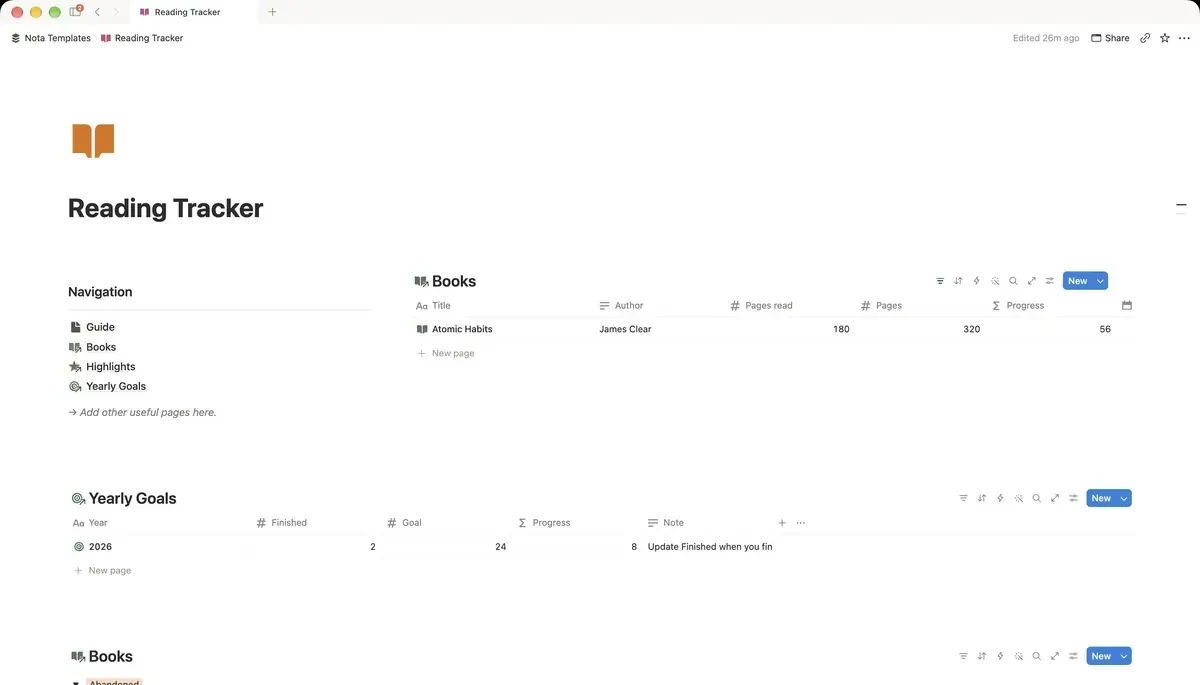
Database 1 — Books
Name it Books, rename the Name column to Book, then add:
- Author — Text.
- Status — a Select: Want to read, Reading, Finished, Abandoned.
- Pages — a Number, and Pages read — a Number.
- Started and Finished — two Date properties.
- Rating — a Select with one to five stars. A number out of ten invites agonising; five options do not.
Abandoned is not a failure state, it is data. A shelf with no abandoned books means you are finishing things out of guilt.
Progress without doing arithmetic
Add a Formula property called Progress:
- if(prop("Pages") > 0, round(prop("Pages read") / prop("Pages") * 100), 0)
Update Pages read when you stop for the night, not every page. The number exists to tell you whether you are 40 pages or 300 from the end, which changes whether you start something else.
Database 2 — Highlights
This is the half people skip, and the half that pays. Name it Highlights, rename the Name column to Quote, then add:
- Book — a Relation pointing at Books.
- Page — a Number, so you can find it again in the physical copy.
- Why it stuck — Text. One line, written in your own words.
The one-line note is what makes the highlight searchable later, because you will search for what it meant to you, not for the author's phrasing.
Make it a shelf, not a spreadsheet
In Books, add a Gallery view grouped by Status. Set the card preview to Page cover, then drop the book's cover image into each page. This is the one place in a Notion build where decoration earns its keep — you recognise a cover far faster than a title, and a shelf you enjoy opening is one you keep updating.
A yearly goal that is a filter, not a feeling
Add a view called This year, filtered where Status is Finished and Finished is within this year. The count at the top of that view is your progress against whatever number you set. No separate goal tracker, no second place to update.
What this does not do
It will not import your Kindle highlights. Notion has no built-in way to pull them in, and the tools that do this are separate services. Typing the three lines that actually mattered is slower, and it is also the reason you remember them.